
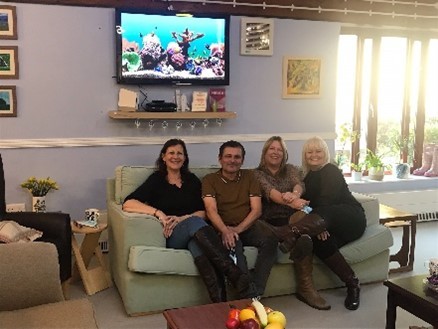
 The Forget Me Not Centre (FMNC) is for people who have progressive memory problems earlier than expected, due to organic illness and who want to make the most of their skills and abilities and keep leading a full and active life. FMNC helps people who are finding it difficult to adapt to practical and emotional changes or who are finding it difficult to come to terms with losing some of their skills. The FMNC aim to enable and support people with early onset dementia to: Reclaim, develop and maintain satisfying, productive and enjoyable lives and find effective ways of managing the symptoms and effects of dementia.
The FMNC believe that occupation and activity gives meaning to life and promotes health and wellbeing. FMNC conducts a thorough assessment of clients’ needs and aims to meet individual goals by matching them to the most appropriate group to achieve this.
Clients take an active part in the success and running of the centre. What happens depends largely on what clients enjoy doing and what they would like to achieve. The group organise and take part in a variety of activities Such as hiking, Gardening, DIY, Cooking, Craft, Art, Sailing, Walking, Film making. We have been involved in living well with dementia projects having worked with Bristol University, Innovations in Dementia, The University of West of England as well as various media outlets.
We meet weekdays and welcome people with early onset dementia.
Latest News- February 2022
Relocation of AWP’s Forget Me Not Centre
The Swindon-based Forget Me Not Centre, which provides care, treatment and support to people with a diagnosis of early onset dementia, has relocated to new premises.
The service, which is run by Avon and Wiltshire Mental Health Partnership (AWP) NHS Trust, is now based at Rosewood, Sandalwood Court, Highworth Road, Swindon, SN3 4WF.
At the Forget Me Not Centre, service users take an active part in running the centre, taking part in a variety of activities such as hiking, gardening and cookery, in order to maintain satisfying, productive and enjoyable lives, while managing the symptoms and effects of dementia.
The facilities feature a pamper room and art studio, as well as kitchen, dining room and lounge, proving service users with the opportunity to take part in activities they enjoy as well as maintaining practical skills.
The Forget Me Not Centre recently held an open day for service users to familiarise themselves with the new facilities.
The team can be contacted on 01793 327880.
News – January 2020:
Three members of the Forget Me Not group in Swindon, have launched a new set of training videos about communication, based on research done in collaboration with the University of Bristol.
Sandy Read, Harry Davis and Roy James have created videos based on research data largely collected by colleagues at the University of Bristol in dementia activity groups, memory cafes and other settings where people with dementia meet each other and engage in activities. Findings from this research are practical and have direct relevance for all of us who communicate regularly with people with dementia. They are much more than “tips for talk”, as interaction unfolds in real time, where one thing that is said always relates directly to what has gone before.
In the videos, we have reconstructed real interactions, creating opportunities for viewers to think about new ways of interacting and perhaps to try them out in practice. Each video raises questions and pauses to allow for discussion. They are not intended to show correct and incorrect ways of communicating, because everyone is different, but they do stimulate reflection on how to overcome those tricky moments that we saw regularly come up and how they could have been avoided or overcome. We finish with the words of Roy, Harry and Sandie, who would like to see this research make a difference to the lives of all people living with dementia: ‘We’ve seen the kinds of things that happen on these videos. These aren’t stories. These are facts of life for us’ (Sandie); ‘There is room for us to learn from each other, and try to do things differently, to make life easier for each other’ (Harry); ‘We hope these videos will travel like wildfire. They are useful for everybody to see’ (Sandie); ‘From the doctors to the patients…We’ve got to get it across to them that people have to listen to us. We are the experts’ (Roy).
The videos are free to use, and can be streamed or downloaded from the University of Bristol’s web-page. http://www.bristol.ac.uk/sps/gettingthingschanged/about-the-project/dementiatalk/dementia-communication-training-videos/
